





Department of Electrical and Computer Engineering

0-2555-2000 to 8519,8520

ece@eng.kmutnb.ac.th

0-2555-2000 to 8519,8520

ece@eng.kmutnb.ac.th

Electrical engineering (AICE)

Bachelor's degree

Artificial Intelligence and Communication Engineering

The importance

of a curriculum

This program is designed to provide educational opportunities for graduates from both general education and vocational education tracks to pursue undergraduate studies and to develop competencies in artificial intelligence engineering and electrical communication engineering. The program aims to equip students with the necessary knowledge and skills to be well prepared for careers in both industrial sectors and academic research. This curriculum emphasizes the enhancement of knowledge and competencies aligned with labor market demands, as well as the economic and social development of the country, while upholding ethical principles and professional standards. Graduates of the program will be able to apply their knowledge to technological development and to create innovations that benefit communities and society at large.

Download Curriculum

Bachelor of Engineering Program in Artificial Intelligence and Communication Engineering 2569-2574

750+

students

43+12

faculty+support

facts & figures

7

Curriculum

4

majors

The objectives

To produce graduates with solid knowledge in artificial intelligence engineering and electrical communication engineering, who are able to apply engineering principles, mathematics, and science to effectively analyze, design, and solve engineering problems.

To produce engineers with expertise in artificial intelligence engineering and electrical communication engineering, who are able to work effectively with others and possess professional communication skills in both Thai and English.

To produce graduates who are able to practice the engineering profession ethically, demonstrate social responsibility, and take environmental sustainability into consideration.

To produce graduates with the ability to manage engineering projects and engage in lifelong learning, enabling them to continuously develop themselves in response to rapid changes in technology and society.

Distinctive Features

Integration of knowledge from two core disciplines: artificial intelligence engineering and electrical communication engineering.

Provision of modern basic electrical and electronics laboratories, as well as specialized laboratories, to enable students to integrate theoretical knowledge and analytical skills with practical hands-on experience prior to entering professional practice.

Alignment with the international labor market, particularly high-technology industries that require engineers capable of working effectively in multinational organizations, both domestically and internationally.

Student Outcome (SO)

SO1 : An ability to apply knowledge of mathematics, science, and engineering.

SO2 : An ability to identify, formulate, and solve engineering problems.

SO3 : An ability to design a system, component, or process to meet desired needs within realistic constraints.

SO4 : An ability to design and conduct experiments, as well as to analyze and interpret data.

SO5 : An ability to use the techniques, skills, and modern engineering tools necessary for engineering practice.

SO6 : An ability to function on multidisciplinary teams.

SO7 : An ability to communicate effectively

SO8 : The broad education necessary to understand the impact of engineering solutions in a global, economic, environmental, and societal context

SO9 : An understanding of professional and ethical responsibility.

S10 : The broad education necessary to understand the impact of engineering solutions in an economic context

S11 : A knowledge of contemporary issues and a recognition of the need for and an ability to engage in life-long learning.

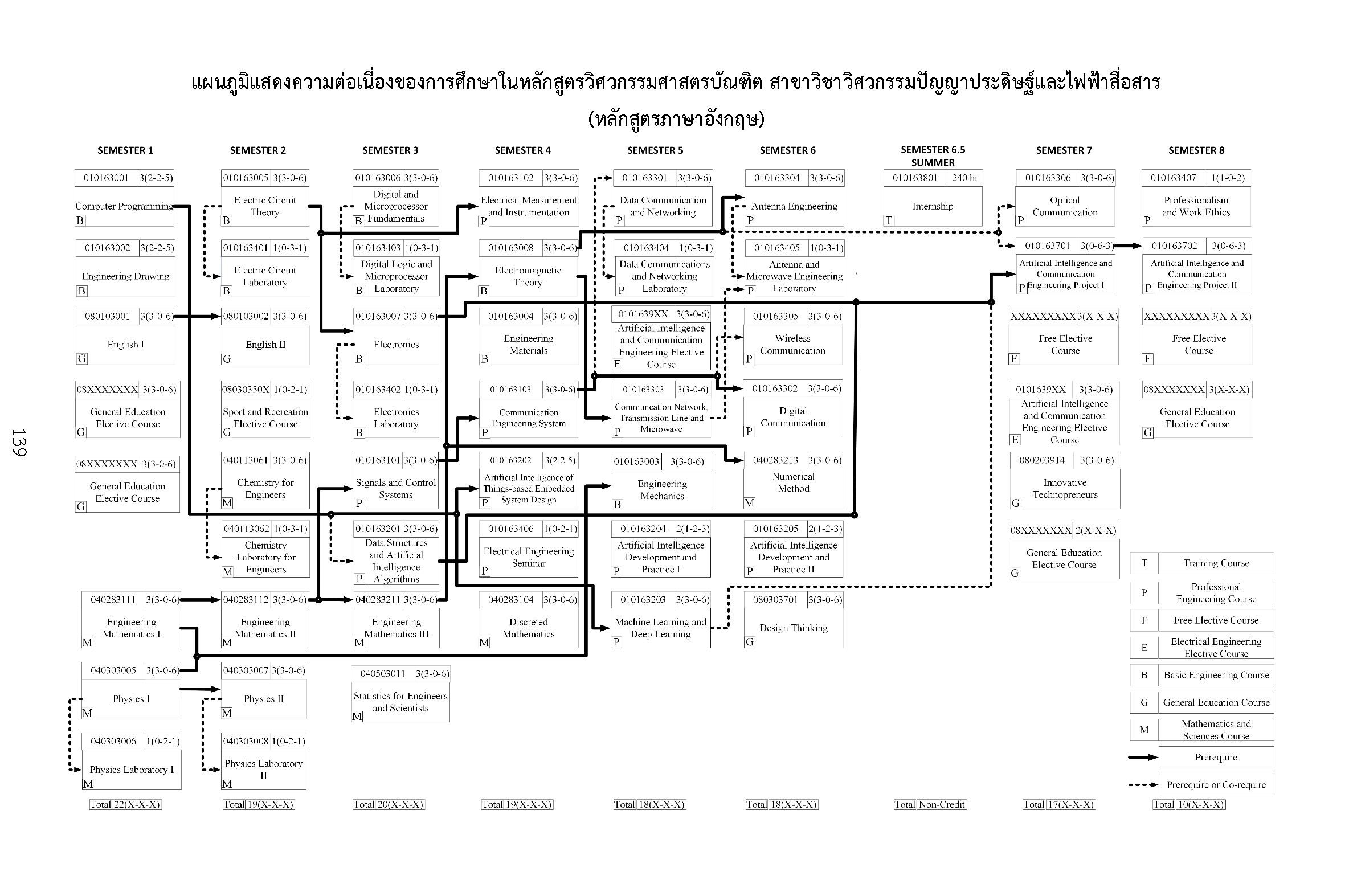
Curriculum flow chart (english program)

E-EE Curriculum coordinator

Assoc. Prof. Dr. Chatree Mahatthanajatuphat (Program Director)
Dr.Vera Sa-ing
Assoc. Prof. Dr. Wilaiporn Lee

Assoc. Prof. Chatchai Sermpongpan
Asst. Prof. Dr. Pennapa Pairodamornchai

Download other Curriculum ..

Your degree in a nutshell

Degree

Duration

Credits

Location

Start

Language

fees

Bachelor of Engineering. (B.Eng.)
(Electrical Engineering)

4 years. (8 Semesters)

143 Credits

Department of Electrical and Computer Engineering, Faculty of Engineering, KMUTNB.

Semester 1 - June to September.

Semester 2 - November to February.

English and Thai.

60,000 Baht/Semester.

Admission requirements

Successfully completing vocational certificate (Vocational Certificate: Voc.) studies in the field of Electrical or Electronics Engineering or..

Successfully completing upper secondary education (Grade 12), with a focus on the Mathematics-Science and Technology learning strand, having undergone studies in the combined subjects of Mathematics, Science, and Technology, totaling not less than 30 credit units or..

Other qualifications must comply with the regulations of King Mongkut's University of Technology North Bangkok regarding the pursuit of a graduate degree.

BACHELOR'S DEGREE
Electrical Engineering (EE)
Electrical Engineering (E-EE)
Computer Engineering
DEGREE
Bachelor of Engineering. (B.Eng.) (Electrical Engineering)
Bachelor of Engineering. (B.Eng.) (Computer Engineering)
MAJORS
- Power Engineering
- Automation Engineering
- Telecommunication Engineering
- Power Engineering
- Automation Engineering
Computer Engineering
DURATION
4 years. (8 Semesters)
CREDITS
149 Credits
149 Credits
127 Credits
START
Semester 1 - June to September. Semester 2 - November to February.
LANGUAGE
Thai and English.
English and Thai.
Thai and English.
FEES
25,000 Baht/Semester.
60,000 Baht/Semester.
25,000 Baht/Semester.
Department of Electrical and Computer Engineering, Faculty of Engineering, KMUTNB.